


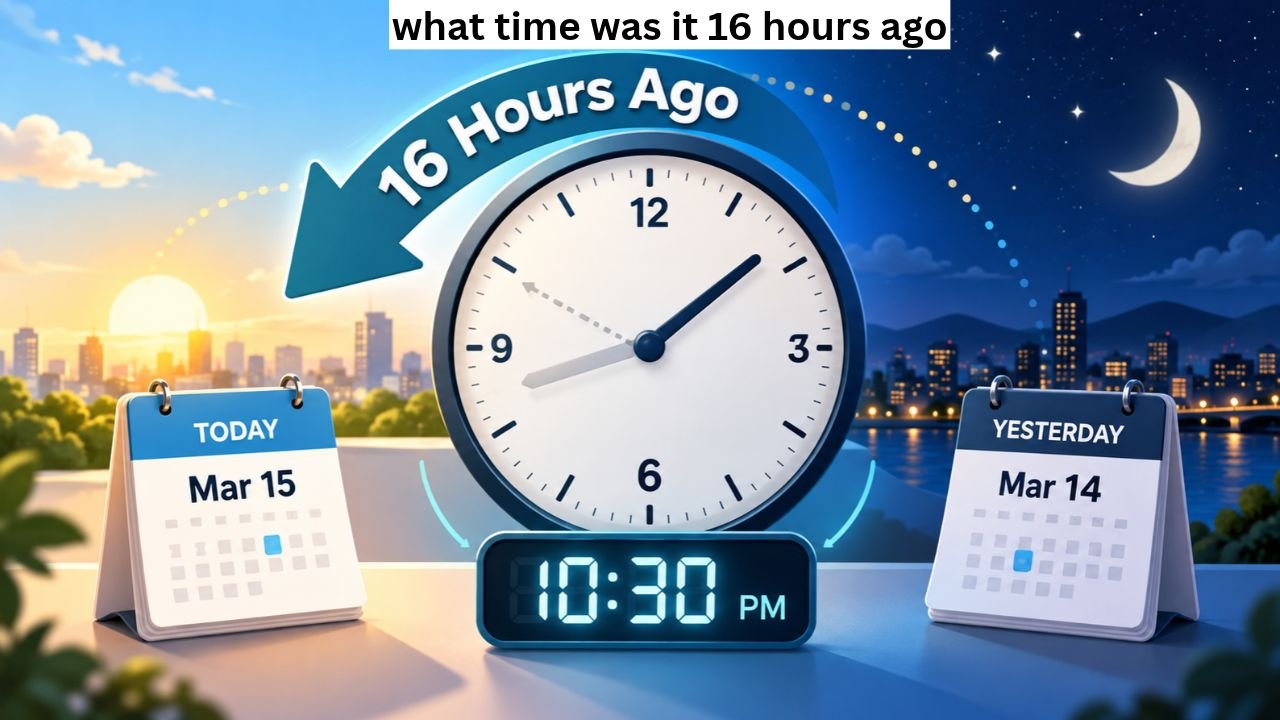
Have you ever looked at a message, post, work log, notification, or timestamp and wondered, “What time was it 16 hours ago?” The answer sounds simple, but subtracting 16 hours can become confusing when the calculation crosses midnight or when different time zones are involved. The key is to treat “16 hours ago” as an elapsed period rather than a fixed clock time. Sixteen hours equals 960 minutes or 57,600 seconds, so the correct answer depends on the exact starting time and time zone. This guide explains how to calculate it manually, determine whether the result falls today or yesterday, and understand the answer for places such as New York, California, Texas, Chicago, Toronto, the UK, and Australia.
What Time Was It 16 Hours Ago?
What time was it 16 hours ago depends on the current local time. Simply subtract 16 hours from the present time while keeping track of the date. For example, if it is currently 10:00 AM, then 16 hours earlier was 6:00 PM on the previous day. If it is 10:00 PM, then 16 hours earlier was 6:00 AM on the same day.
The basic formula is:
Current time − 16 hours = time 16 hours ago
Sixteen hours represents two-thirds of a 24-hour day. Because of that, the calculation frequently crosses midnight, which is why checking the date as well as the clock time is important. Time-calculator sites similarly treat the calculation as subtracting 16 elapsed hours from the current timestamp rather than simply changing the displayed hour. (dateandunits.com)
How to Calculate 16 Hours Ago Step by Step
You can work out the answer without a calculator by following a simple process.
Step 1: Write the Current Time
Start with the exact time right now. If your clock uses AM and PM, converting it to the 24-hour format can make the calculation easier.
For example:
8:30 AM → 08:30
7:45 PM → 19:45
Step 2: Subtract 16 Hours
Now subtract 16 from the hour.
Suppose the current time is 8:30 AM:
08:30 − 16 hours = −07:30
Because the result is below zero, the calculation has crossed midnight.
Step 3: Add 24 Hours
Add 24 hours to the negative result:
−07:30 + 24:00 = 16:30
That equals 4:30 PM.
Step 4: Move Back One Calendar Day
Because you crossed midnight while counting backward, the result occurred yesterday.
So, if it is 8:30 AM today, 16 hours ago was 4:30 PM yesterday.
Step 5: Check the Result
A useful verification method is to add 16 hours to your answer. If you return to the original time, your calculation is correct.
This approach also works when calculating 15, 17, 18, or any other number of hours ago.
Is 16 Hours Ago Yesterday or Today?
This is one of the most common points of confusion.
On an ordinary day, if the current time is before 4:00 PM, going back 16 hours crosses midnight, so the result falls on yesterday. At exactly 4:00 PM, 16 hours earlier is midnight at the beginning of the same calendar date. After 4:00 PM, the result normally remains on the current calendar date. (CalendarHours)
| Current Time | 16 Hours Ago | Calendar Result |
|---|---|---|
| 6:00 AM | 2:00 PM | Yesterday |
| 9:00 AM | 5:00 PM | Yesterday |
| 12:00 PM | 8:00 PM | Yesterday |
| 3:00 PM | 11:00 PM | Yesterday |
| 4:00 PM | 12:00 AM | Today |
| 6:00 PM | 2:00 AM | Today |
| 9:00 PM | 5:00 AM | Today |
| 11:00 PM | 7:00 AM | Today |
The important detail is that 16 hours ago is not automatically yesterday. It depends on the current time.
What Time Was It 16 Hours Ago From Now?
The phrase what time was it 16 hours ago from now describes a moving calculation. There is no single permanent clock answer because “now” changes every second.
For example, if the current time is 2:15 PM, subtracting 16 hours gives 10:15 PM yesterday. If the current time later becomes 8:15 PM, the answer becomes 4:15 AM today.
That is why a live calculator should calculate the result from the moment it is opened instead of displaying a permanently fixed answer. The exact result should ideally include the time, date, and time zone so there is no ambiguity. (calculator.name)
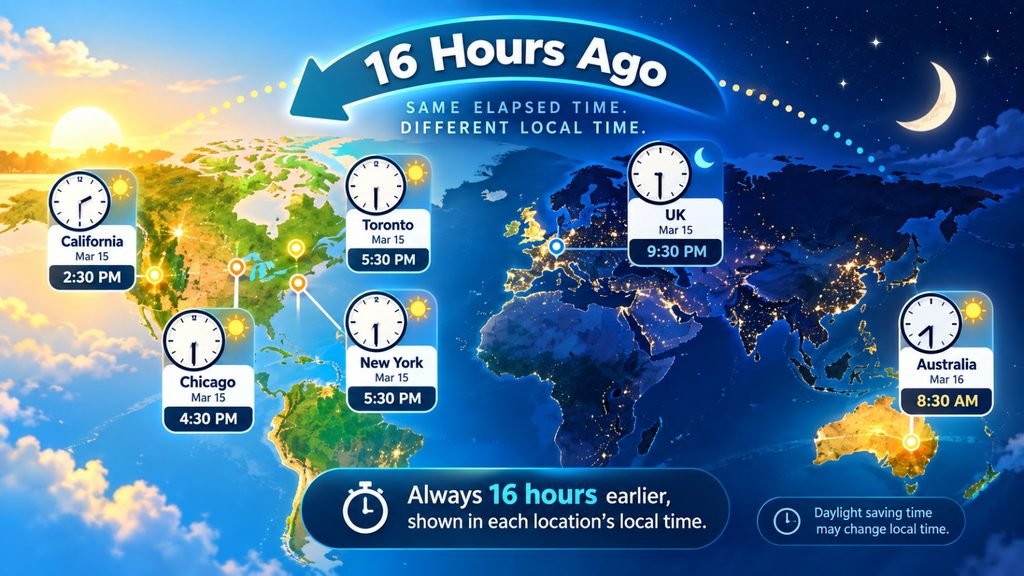
What Time Was It 16 Hours Ago in Different Locations?
The elapsed period is always 16 hours, but the displayed clock time depends on the location. This matters when someone in one city is comparing a timestamp with someone in another city.
Eastern Time: New York and EST
For searches such as what time was it 16 hours ago EST, first identify whether the location is currently observing Eastern Standard Time or Eastern Daylight Time. In October 2026, New York and other Eastern Time locations are still observing daylight time until the November clock change, so the applicable abbreviation is EDT, not EST. (Time and Date)
The calculation itself remains unchanged: take the current Eastern Time and subtract 16 elapsed hours.
California
For what time was it 16 hours ago in California, use Pacific Time. California observes Pacific Standard Time during part of the year and Pacific Daylight Time during daylight-saving time. In October 2026, California is on PDT (UTC−7) until the November transition. (Time and Date)
Therefore, calculate the 16-hour difference using the California local clock rather than assuming California has the same time as New York.
Central Time and Chicago
For searches such as what time was it 16 hours ago CST or what time was it 16 hours ago in Chicago, use Central Time and check whether daylight saving time is active.
Chicago normally switches between CST and CDT. During daylight-saving time, the local abbreviation is CDT, while CST is the standard-time abbreviation. The same distinction applies to much of Texas and Illinois.
Texas
The question what time was it 16 hours ago in Texas requires a small qualification because Texas spans two time zones. Most of Texas uses Central Time, while El Paso and some nearby areas use Mountain Time. (Time and Date)
So, Houston and Dallas will generally produce a different local clock reading from El Paso when comparing the same instant.
Arizona
For what time was it 16 hours ago in Arizona, remember that most of Arizona follows Mountain Standard Time throughout the year and generally does not observe daylight saving time. Some areas, however, have different rules. (Time and Date)
This makes Arizona an important example of why simply assuming every nearby state changes its clock in the same way can produce an incorrect result.
Toronto and New York
Toronto and New York currently share the same Eastern Time clock schedule. Toronto was observing EDT (UTC−4) in October 2026, with the next transition to EST scheduled for November 1, 2026. (Time and Date)
Therefore, what time was it 16 hours ago in Toronto can generally be calculated using the same local clock arithmetic as New York for the same date and period.
What Time Was It 16 Hours Ago in the UK?
For what time was it 16 hours ago from now UK or what time was it 16 hours ago UK, use the UK’s current local time rather than automatically assuming GMT.
The UK changes between Greenwich Mean Time and British Summer Time. Therefore, the correct historical clock reading depends on the date being examined. The safest method is to identify the exact UK timestamp first, subtract 16 elapsed hours, and then apply the appropriate local time-zone rules.
This distinction is particularly useful when comparing UK timestamps with American or Canadian locations.

What Time Was It 16 Hours Ago in Australia?
Australia is more complicated because it does not use one nationwide clock. Different parts of the country use different time zones, and some locations observe daylight saving while others do not.
For that reason, what time was it 16 hours ago in Australia should always specify a city or state, such as Sydney, Melbourne, Brisbane, Perth, or Adelaide.
The calculation remains straightforward once the correct local time zone is established: current local timestamp − 16 elapsed hours.
Why Time Zones and Daylight Saving Matter
A 16-hour duration is fixed: 16 hours = 960 minutes = 57,600 seconds. (CalendarHours) However, the displayed clock time can be affected by daylight-saving transitions.
For example, the United States changes many clocks twice each year, and the 2026 fall transition occurs on November 1. (Time and Date) During a clock-change period, subtracting elapsed hours from a timestamp is more reliable than simply manipulating the visible hour number.
This is especially important when reviewing international messages, travel records, online activity timestamps, work logs, or digital events that cross a daylight-saving transition.
Common Mistakes When Calculating 16 Hours Ago
The most frequent mistake is forgetting to change the date after crossing midnight. Someone may correctly calculate the clock time but incorrectly label it as today instead of yesterday.
Another common mistake is confusing 16 hours ago with 16 hours from now. The first moves backward in time, while the second moves forward.
People also sometimes use EST, CST, or PST as though those abbreviations apply throughout the entire year. In locations that observe daylight saving, the applicable abbreviation can change. Using the location’s actual time-zone rules gives a more reliable answer.
Finally, remember that “16 hours ago” is relative to the exact moment of calculation. A result you calculate now will eventually become outdated as the current time changes.
FAQ: What Time Was It 16 Hours Ago?
1. What time was it 16 hours ago?
To find what time was it 16 hours ago, subtract 16 hours from your current local time. If the subtraction crosses midnight, move the date back one day. The exact result changes continuously because “now” changes continuously.
2. How many minutes are in 16 hours?
Sixteen hours equals 960 minutes. It also equals 57,600 seconds and 57,600,000 milliseconds. These conversions are useful when working with timestamps, digital logs, timers, or software that records elapsed time in smaller units.
3. Was 16 hours ago yesterday?
Sometimes. If the current time is before 4:00 PM, subtracting 16 hours normally crosses midnight and places the answer on the previous calendar day. If the current time is after 4:00 PM, the result normally remains on today’s date.
4. What time was it 16 hours ago in New York?
Use the current New York local time and subtract 16 elapsed hours. Remember that New York switches between Eastern Daylight Time and Eastern Standard Time, so the correct abbreviation depends on the date being calculated.
5. What time was it 16 hours ago in California?
Use California’s Pacific Time and subtract 16 hours. California changes between PDT and PST during the year, so the exact time-zone abbreviation depends on the date. The calculation should use the local timestamp rather than assuming a permanent UTC offset.
6. What time was it 16 hours ago in Chicago?
Chicago uses Central Time. Subtract 16 elapsed hours from the current Chicago time and adjust the calendar date if necessary. Also check whether the date falls under CDT or CST because daylight-saving rules can affect the local clock.
7. Can I calculate 16 hours ago from a specific time?
Yes. Start with any exact date, time, and time zone, then subtract 16 elapsed hours. For example, if a timestamp is 7:00 AM, 16 hours earlier is 3:00 PM on the previous calendar day.
Conclusion
Finding what time was it 16 hours ago is ultimately a simple subtraction problem, but getting the complete answer requires attention to the date and time zone. The basic formula is current time minus 16 hours, while 16 hours itself equals 960 minutes or 57,600 seconds. If the calculation crosses midnight, the calendar date must also change. For international comparisons, use the correct local time zone and account for daylight-saving rules rather than relying on abbreviations such as EST or CST without checking the date.
For More Trending Stories, Explore vibeceleb
